Contrast on the palate: how salt, heat and cold make fruit taste brighter
Ask a cook why watermelon gets a pinch of salt, why a mango salad gets fresh chilli, or why lemonade is served over ice, and the answer is usually the same: it tastes brighter. That word hides a surprising amount of science. Brightness is rarely about adding more of the fruit. It is about putting something next to the fruit that pushes against it, so that the fruit has an edge to stand out from.
Taste, aroma and the third sense
This guide is about that push. It looks at the four contrasts that turn up again and again in fruit flavours, in kitchens and in the flavour houses that design recipes for a living: salt, heat, cold and acidity. For each one it explains what is happening on the tongue and in the nose, which fruits respond best, and where a contrast tips over from lifting a flavour to drowning it. It ends with a simple method for tasting contrasts at home, and a checklist.
Before contrast makes sense, it helps to separate three things that everyday language lumps together as "flavour".
Taste is what the tongue itself detects. There are five widely accepted basic tastes: sweet, sour, salty, bitter and umami. Each is picked up by its own family of receptors, and each tells the brain something simple. Taste is coarse. It cannot tell a strawberry from a raspberry; both are just sweet and a little sour.
Aroma is what does the telling apart. Volatile molecules from food travel up the back of the throat to the nose while we chew, a route called retronasal smell. Hundreds of compounds contribute, and the particular balance of them is what makes a peach a peach. When a heavy cold blocks the nose, food suddenly tastes flat; the tongue is still working, but the aroma is gone.
The third sense is the one most people have never heard named. Chemesthesis is the body's ability to feel chemicals as touch, temperature or pain. The burn of chilli, the tingle of ginger, the cool of a mint, the prickle of carbonation and the dryness of strong tea are all chemesthetic. They are not tastes and they are not smells. They arrive through the same nerve endings that report heat, cold and pressure.
Contrast works across all three channels at once. Salt is a taste that changes how other tastes are perceived. Heat and cold are chemesthetic sensations that change how aroma is perceived. Acidity is a taste that changes almost everything. Keeping the three channels apart makes it much easier to see why a particular pairing works.
| Channel | Detected by | Examples | What contrast does here |
|---|---|---|---|
| Taste | Receptors on the tongue | Sweet, sour, salty, bitter, umami | One taste suppresses or boosts another |
| Aroma | Smell receptors, via the back of the throat | Peach, cherry, lime, violet | Gives the brain a background to read the fruit against |
| Chemesthesis | Nerve endings for touch, heat and cold | Chilli burn, ginger tingle, cooling, fizz | Adds an edge and changes how long the flavour lasts |
Table 1. The three channels of flavour. Contrast can act through any of them, and the best pairings usually use two.
Why contrast makes things brighter
The senses are built to notice change, not steady states. A smell that does not vary fades within minutes; a sound that never stops is soon ignored. This is called adaptation, and it applies to flavour too. A mouthful that is only sweet becomes less sweet with every second, because the receptors that report sweetness are turning themselves down.
A contrasting element interrupts that fade. When salt, heat, cold or sourness arrives alongside the fruit, the brain has two signals to compare, and comparison is something it does very well. The fruit no longer sits on a blank background; it sits next to something that is clearly not fruit. Its outline sharpens.
There is also a second, quieter mechanism. Several basic tastes interfere with each other directly, a process known as mixture suppression. Bitterness and sourness, for example, are both reduced by a little salt. When a dull, slightly bitter edge is taken away, the sweetness and the aroma that were already there come forward. Nothing has been added to the fruit, yet it tastes like more of itself.
A good contrast does not add a flavour. It removes the reasons the fruit was tasting dull.
Both mechanisms have the same limit: the contrast has to stay in the background. Once the salt, heat or cold becomes the first thing noticed, the brain stops comparing and starts simply reporting the loudest signal. The skill in every contrast, from a chef's seasoning to a recipe developer's formula, is stopping just before that point.
Salt and fruit
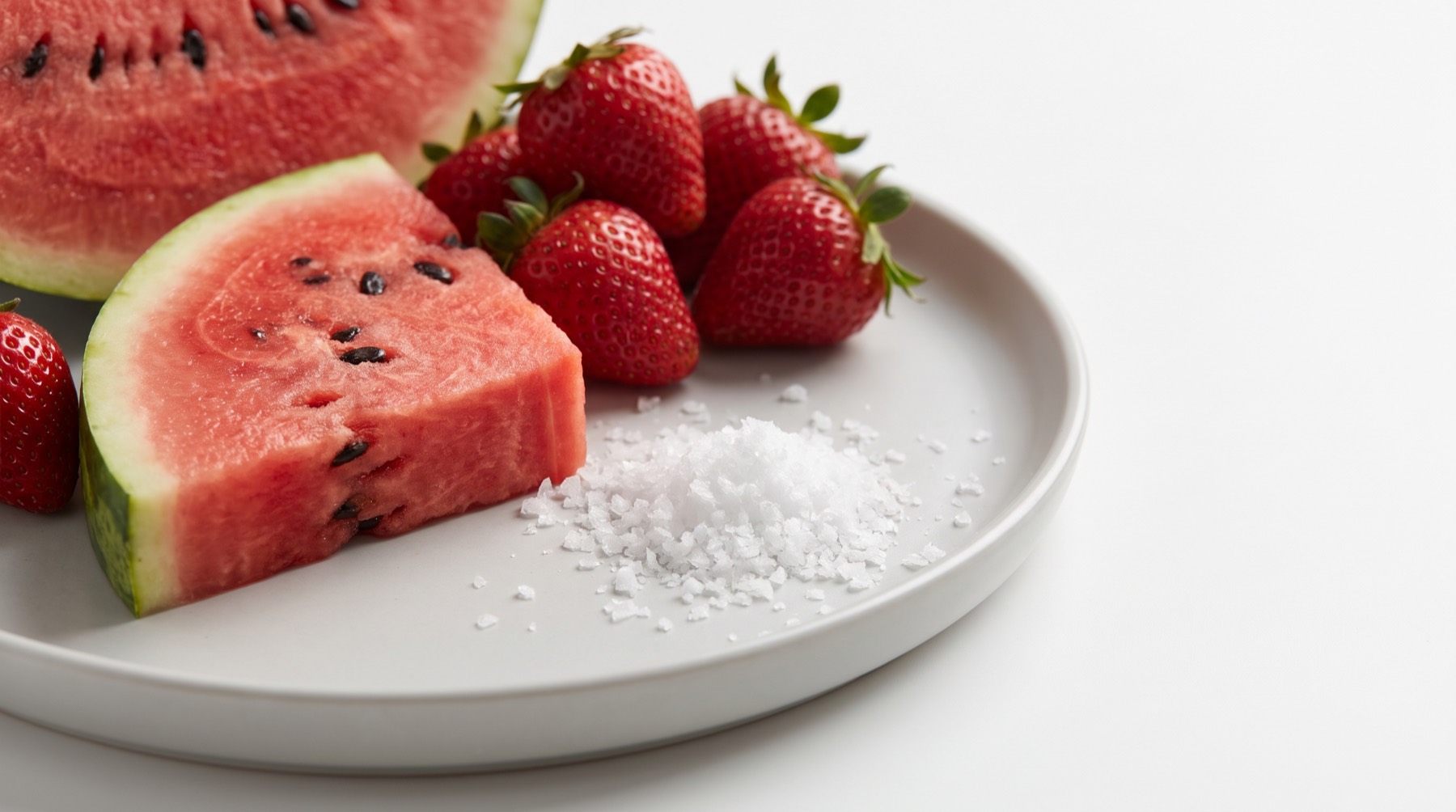
Salt with fruit sounds odd to many people in the United Kingdom, yet it is everyday practice across much of the world. Mexican street vendors dust mango and cucumber with salt and chilli. Thai markets sell sour green fruit with a dip of salt, sugar and dried chilli. Japanese cooks salt watermelon. Salted caramel, now a fixture of British dessert menus, uses the same principle on sugar.
The reason it works is mostly suppression. Many fruits carry a faint bitterness from their skins, seeds or less ripe flesh, and a sharp sourness from their acids. Salt quietens both. What remains is the sweetness and the aroma, which now come across as rounder and riper. At very low levels salt is not recognised as salty at all; it simply makes the fruit taste "more finished".
Salt also helps aroma in a small physical way. Dissolved salt makes it slightly harder for some aroma molecules to stay in the water of the food, so more of them escape into the air and reach the nose. The effect is modest, but it is part of why salted fruit can smell stronger as well as taste sweeter.
Not every fruit benefits equally. Watery, mild fruits have the most to gain, because their sweetness is easy to lose. Berries with a strong sour note also do well, because salt takes the sharpness down a step. Very sweet, very aromatic fruits gain less, and floral flavours need the lightest touch of all: a violet or a rose note is delicate, and salt can flatten it if it is not kept well in the background.
| Fruit or note | What it lacks alone | What salt does | How much contrast |
|---|---|---|---|
| Watermelon | Sweetness fades fast, watery finish | Holds the sweetness, removes a slight grassiness | Generous |
| Strawberry | Can be tart or flat out of season | Softens the tartness, makes the aroma jammier | Moderate |
| Raspberry | Sharp, seedy edge | Takes the edge off, brings out the floral side | Moderate |
| Lime | Very sour, slightly bitter peel | Reduces both, leaves a clean citrus note | Moderate |
| Violet and other florals | Delicate, can read as perfume | Grounds the note, but flattens it easily | Very light |
| Mango and peach | Rich and sweet already | Little gain; works better with heat | Light |
Table 2. How common fruit notes respond to salt. "How much contrast" is a relative guide for tasting, not a measurement.
The practical test is simple. Taste a slice of fruit on its own, then the same fruit with a few grains of flaky salt. If the salted slice tastes sweeter and you cannot quite name the salt, the contrast is in the right place. If the first word that comes to mind is "salty", it has gone too far.
Heat: fiery, zingy and warm
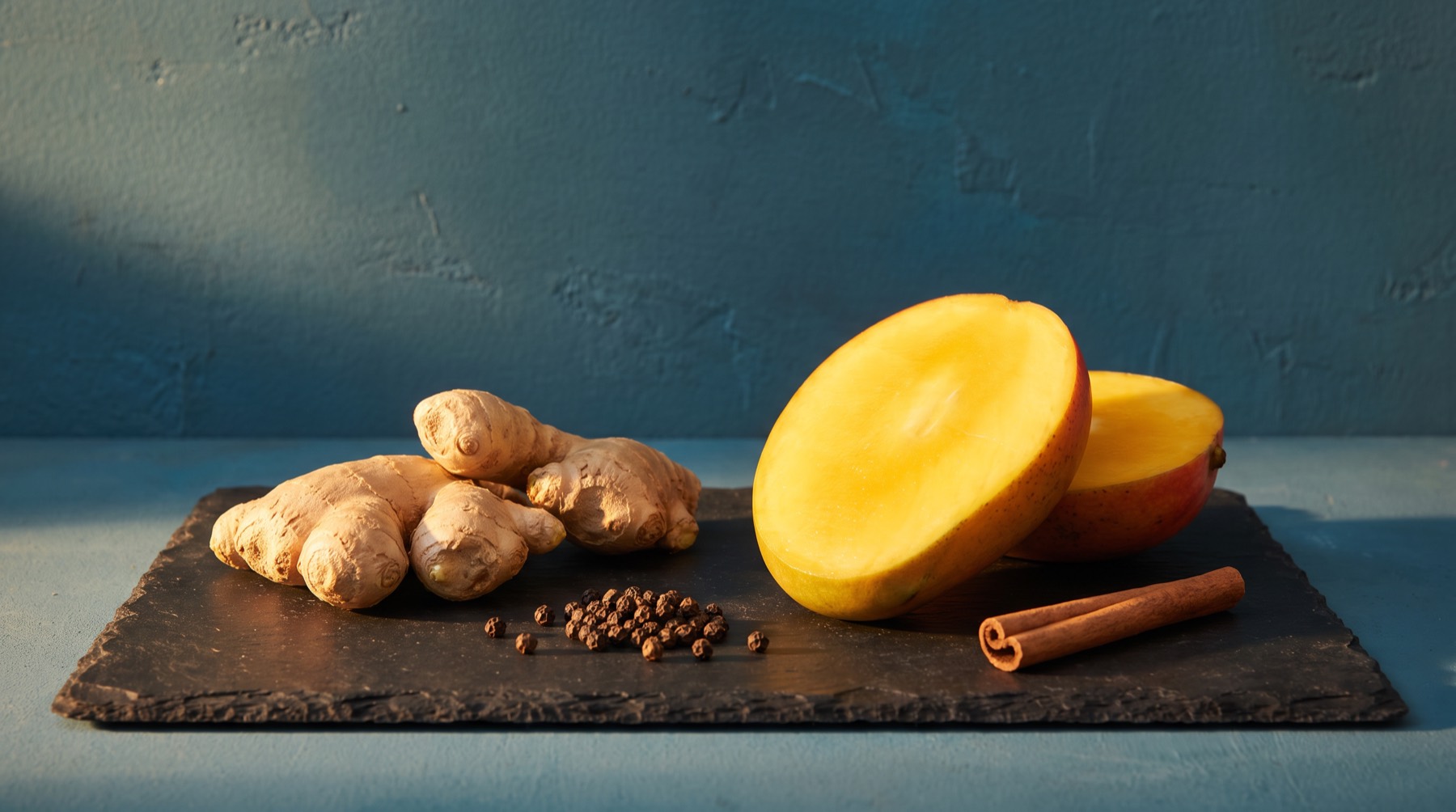
Heat is the contrast that confuses people most, because it feels so much like a taste. It is not. Chilli, ginger and black pepper act on the nerve endings that report temperature and pain, which is why the mouth can feel "hot" from food at room temperature.
The main sensor involved is a receptor called TRPV1, which normally responds to real heat above roughly 43 °C. Capsaicin from chilli fits the same receptor and switches it on, so the brain receives a heat signal with no heat present. Piperine from black pepper acts on TRPV1 and a related receptor. Gingerol and shogaol from ginger do too, which explains why ginger warms rather than burns: its compounds are weaker at the receptor, and they also stimulate a second sensor, TRPA1, that produces the familiar tingle and zing.
Why does heat suit fruit so well? Partly through contrast: the brain reads a sweet, round fruit more clearly against a sharp, prickly background. Partly through timing: heat builds more slowly than sweetness, so a bite of chilli-dusted peach opens sweet and finishes warm, stretching the flavour over a longer arc. And partly through saliva: heat makes the mouth water, which carries aroma and keeps the fruit noticeable for longer.
The fruits that pair best with heat tend to share two traits: plenty of sugar and a strong, ripe aroma. Mango, peach and pineapple are the classic partners. Citrus works for a slightly different reason; its sharp acidity and the zing of ginger both live at the front of the mouth, and together they produce the bright, almost electric effect that cooks call "zingy".
| Source | Main compound | Character | Onset | Natural partners |
|---|---|---|---|---|
| Chilli | Capsaicin | Burning, lingering | Slow, builds over seconds | Mango, peach, pineapple, lime |
| Ginger | Gingerol, shogaol | Warm, tingling, zingy | Medium | Lime, lemon, peach, pear |
| Black pepper | Piperine | Sharp, woody, brief | Fast | Strawberry, cherry, melon |
| Cinnamon | Cinnamaldehyde | Sweet warmth, slightly drying | Fast | Apple, pear, plum, cherry |
| Sichuan pepper | Sanshool | Buzzing, numbing | Medium | Citrus, blackcurrant |
Table 3. Common sources of warmth and how each behaves. Onset describes the order in which sensations are typically noticed, not a timed measurement.
Two cautions apply to heat as a contrast. First, it accumulates. Each mouthful adds to the last, so a level that feels gentle at the first taste can feel strong by the fifth. Second, it masks aroma when it is high. The burn competes for attention, and at some point the fruit becomes impossible to pick out. The well-judged fiery fruit flavour is one where the fruit is still clearly named after the heat has peaked.
Cold: freezing, chilled and fresh
Cold works on fruit in two separate ways: real cold, from ice or a refrigerator, and felt cold, from cooling compounds that trick the nerves the way capsaicin tricks them with heat.
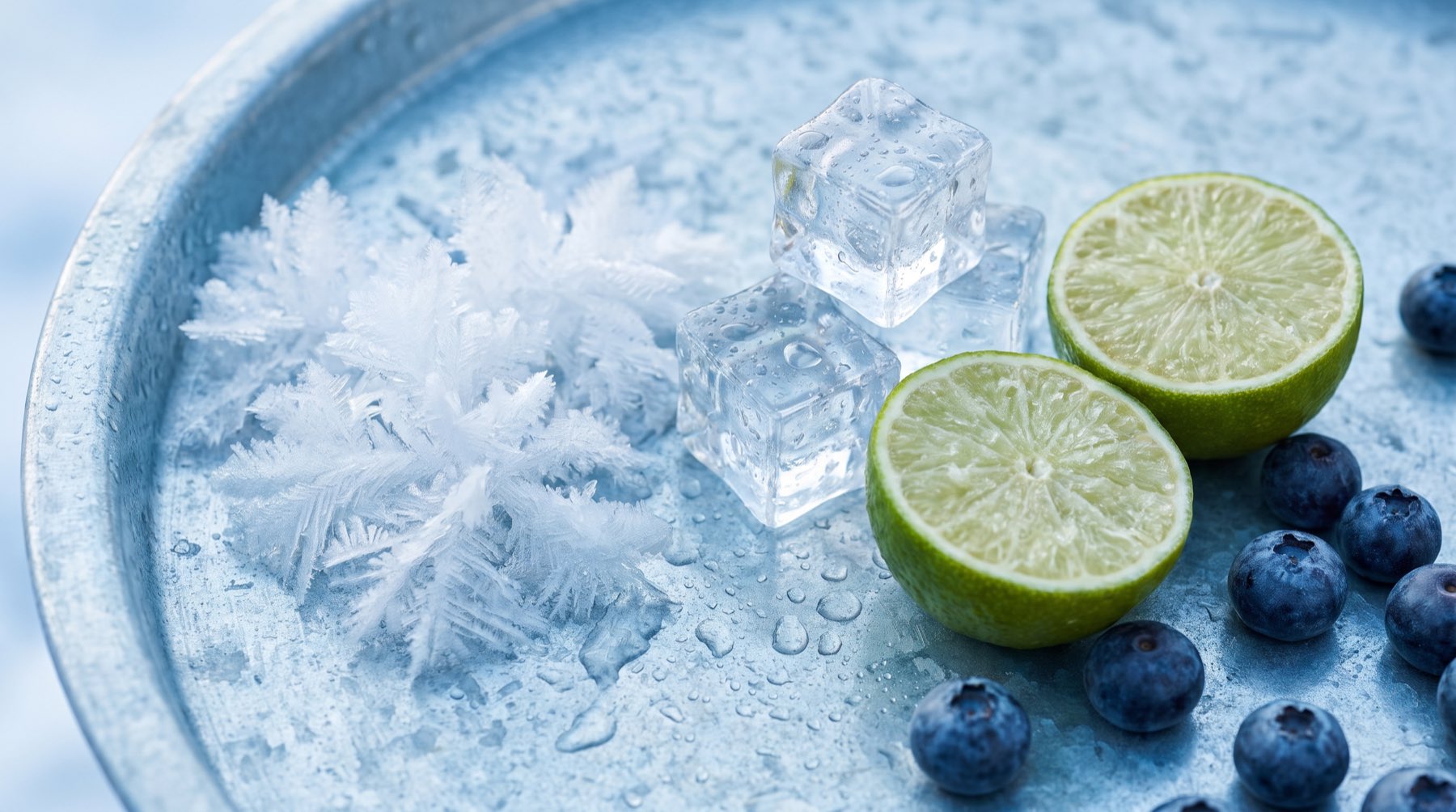
Real cold changes taste directly. Sweetness drops noticeably as temperature falls, which is why melted ice cream tastes far sweeter than frozen, and why a warm cola is so cloying. Sour and bitter are much less affected. The result is that a chilled fruit tastes less sweet and relatively more tart, crisper and more "refreshing". Cold also slows the release of aroma, so very cold fruit smells of less until it warms a little in the mouth.
Felt cold comes mostly through a receptor called TRPM8, which responds to temperatures below about 25 °C. Menthol from mint switches it on, and so do a family of cooling compounds developed by flavour chemists that cool without any minty taste. These are what allow a recipe to feel icy while tasting of cherry or watermelon. They also tend to last longer than real cold, which fades as soon as the food warms up.
As a contrast, cold suits fruits whose appeal is freshness rather than richness. Cherry, watermelon, blueberry and citrus all carry a light, juicy character that cold emphasises. Rich fruits such as mango or banana can feel muted when strongly chilled, because their sweetness and their heavy aroma are exactly what cold suppresses.
There is an interesting interaction between cold and heat. The receptors for each can influence the other, and many people find that a cool element softens the edge of a hot one. A flavour that combines both, such as a cool mint with a warm spice, can feel layered rather than muddled, provided one leads and the other follows.
Acidity: tang, sharpness and lift
Acidity is so central to fruit that it is easy to forget it is a contrast at all. Almost every fruit contains acids, and the balance between sugar and acid is what separates a lively fruit from a bland one. Fruit breeders and growers measure that balance routinely; a strawberry with plenty of sugar but too little acid tastes flat, however sweet it is.
The acids differ, and each has its own personality. Citric acid, found in citrus and berries, gives a quick, bright sharpness that fades fast. Malic acid, the main acid of apples, pears and cherries, is smoother and lingers longer, giving the clean, mouth-watering sourness of a green apple. Tartaric acid, common in grapes, is harder and drier. Many recipes blend acids to build a sourness that starts quickly and lasts, rather than spiking and vanishing.
Acidity pairs naturally with the other contrasts. Salt softens it, which is why a pinch of salt can rescue an over-sharp berry. Cold leaves it standing while lowering sweetness, which is why chilled citrus tastes so crisp. And heat and acidity together produce the bright, front-of-mouth sharpness of a ginger and lime combination. Prickly pear, a fruit whose flavour sits somewhere between melon and berry, is often served with lime for exactly this reason: alone it can taste faint, and the acid gives it shape.
Front, middle and finish
Professional tasters rarely describe a flavour as a single thing. They describe it over time: what arrives first, what fills the middle, and what is left at the end. This vocabulary is the most useful tool for understanding contrast, because each contrast works at a different moment.
- Front. The first second or two. Sweetness, sourness, saltiness and fast acids such as citric arrive here, along with real cold.
- Middle. The bulk of the experience. Aroma develops as the food warms and is chewed. This is where the fruit should be most clearly recognisable.
- Finish. What lingers after swallowing. Slow heat from chilli, longer acids such as malic, cooling compounds and any bitterness all show up here.
Seen this way, a well-built contrast flavour is a relay. A salted fruit makes the front rounder and the middle sweeter. A fiery fruit opens sweet and hands over to warmth at the finish. A chilled fruit is crisp at the front and leaves a clean, cool finish. Problems arise when two contrasts compete for the same moment, such as a strong sourness and a strong salt both hitting the front, and the fruit in the middle gets squeezed out.
How recipe developers balance a contrast
Flavour houses, confectioners and drinks makers develop contrast flavours in a broadly similar way, and the outline of their process is useful for anyone who wants to taste more carefully.
- Start with the fruit. The fruit note is built first and judged on its own. If it is not clearly recognisable alone, no contrast will rescue it.
- Add the contrast in small steps. Developers taste a series of samples with the contrast at rising levels, often in fixed increments, and note where the fruit stops getting brighter.
- Find the recognition threshold. The best level is usually just below the point where tasters can name the contrast on its own. Above it, the contrast becomes the headline.
- Check over time. Heat and cooling are judged over several minutes, not a single sip, because both accumulate and both affect the finish.
- Test with fresh tasters. People who have been tasting for an hour adapt to the contrast and start to under-notice it. Fresh panels catch levels that have crept too high.
The same logic explains why one name can cover several strengths. A "fiery" fruit flavour might exist at a gentle and a pronounced level, and a "freezing" one at a mild and an intense level. The fruit is the same; the amount of contrast around it is what changes.
Common pairings, and why they work
Most contrast flavours draw from a fairly small set of proven pairings. Knowing the reason behind each makes it easier to predict how an unfamiliar combination will behave.
- Peach with chilli. A rich, sweet, aromatic fruit against a slow burn. The peach leads, the heat arrives late and extends the finish.
- Lime with chilli or ginger. Two sharp, front-of-mouth sensations that reinforce each other. Bright, fast and clean.
- Mango with chilli. The street-food classic. Mango is sweet enough to stand up to real heat without disappearing.
- Strawberry with salt. Salt removes tartness and rounds the aroma into something closer to jam.
- Raspberry with salt. Takes off the seedy sharpness and brings forward the fruit's floral side.
- Cherry with cold. Cherry's tart, almond-like aroma stays clear when sweetness is turned down, so it reads as fresh rather than sugary.
- Watermelon with cold and a touch of mint. A light, watery fruit that depends on freshness, given a cool finish so it does not fade.
- Blueberry with mint. A mild berry that gains definition from a cool, clean background.
- Blackcurrant on its own. Unusually, blackcurrant brings its own contrast: strong acidity and a slightly green, resinous edge that keeps it from ever tasting flat.
Where contrast goes wrong
Contrast is forgiving, but a few failures turn up again and again.
- Too much. The most common problem by far. The contrast becomes the flavour, and the fruit becomes an afterthought.
- Two contrasts in one slot. Heavy salt and heavy sourness both at the front, or strong heat and strong cooling both in the finish, so they cancel rather than relay.
- A weak fruit. Contrast sharpens an outline; it cannot create one. A faint or confused fruit note simply becomes a faint fruit with a strong edge.
- The wrong fruit for the contrast. Strong cold on a rich fruit, or strong salt on a delicate floral note, removes the very quality the fruit was chosen for.
- Ignoring accumulation. Judging heat or cooling from a single taste and missing how much it builds.
A ten-point checklist for tasting contrasts at home
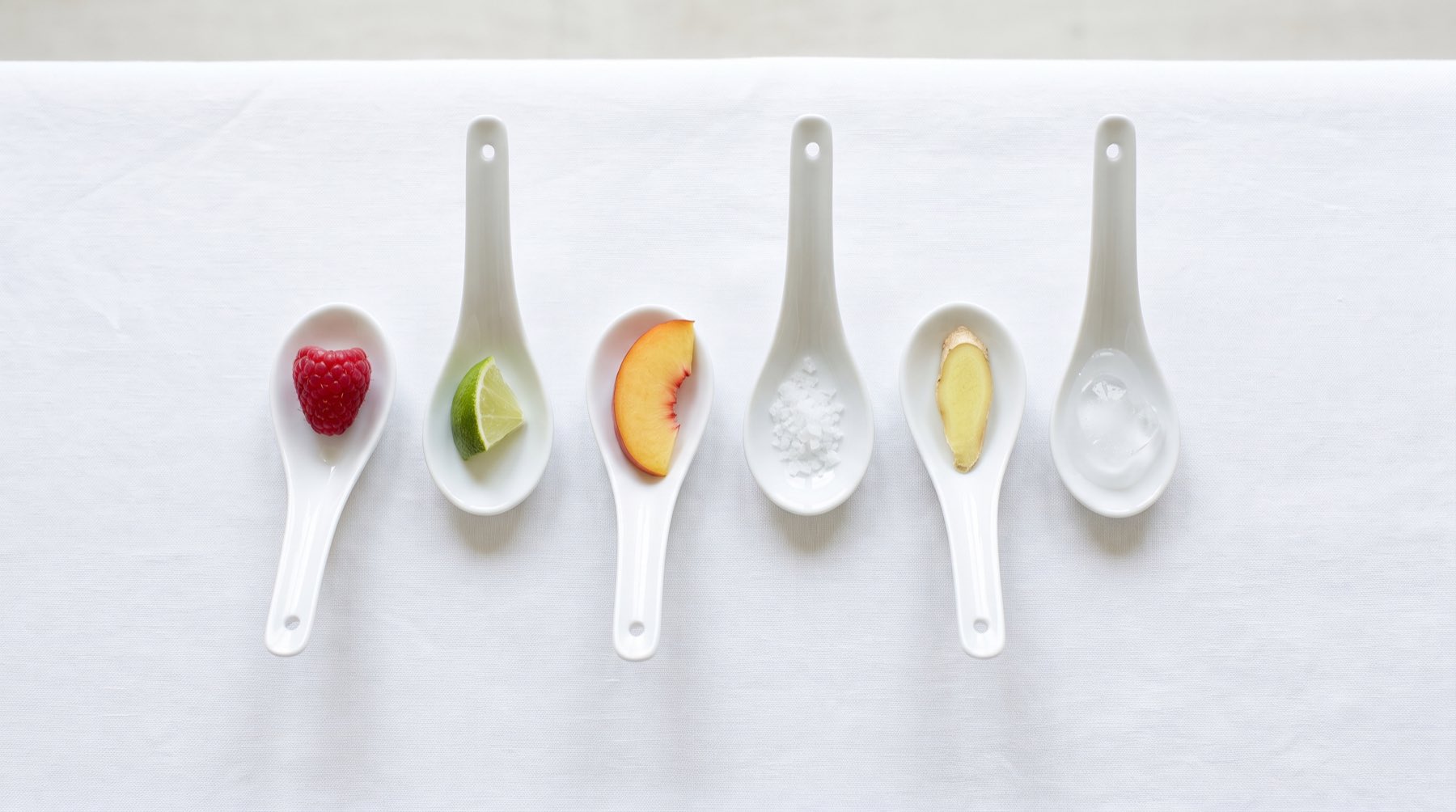
The tasting-spoon method needs nothing more than a few spoons, a fruit or two, and something to contrast it with. It is a good way to train the palate, and it makes the ideas in this guide concrete very quickly.
- Taste the fruit alone first. Every judgement depends on knowing what the fruit tastes like without help.
- Change one thing at a time. Salt, heat, cold or acid, never two at once, or you will not know which one did the work.
- Start with less than you think. A few grains of salt, a single thin slice of chilli, one small ice chip. It is easy to add and impossible to take away.
- Taste in pairs. Plain fruit, then contrasted fruit, straight after. The comparison is what teaches.
- Name the fruit, then the contrast. If you notice the contrast first, the level is too high.
- Notice the moment. Ask whether the change happened at the front, in the middle or in the finish.
- Wait with heat and cooling. Give each sample a minute before deciding, and expect both to build.
- Reset between samples. Plain water and a short pause. A plain cracker helps after heat.
- Mind the temperature. Compare samples at the same temperature unless temperature is what you are testing.
- Write it down. A few words per spoon. After two or three sessions the patterns in this guide become your own observations rather than someone else's.
Contrast is one of the oldest ideas in cooking and one of the most useful in flavour design. Salt rounds, heat extends, cold sharpens, acid lifts. Used lightly and one at a time, each of them makes fruit taste more like itself. Used heavily, each of them takes its place. The whole craft lies in knowing the difference, and the quickest way to learn it is with a spoon in each hand.